

Timely referrals,
better outcomes.
Cochlear implantation can be considered for children and adults of any age, with bilateral severe-to-profound hearing loss when well-fitted hearing aids do not provide enough functional benefit. The procedure is more effective with shorter deafness durations — timely referrals are advised.
Broad indications for referral.
The audiogram below illustrates the broad thresholds we use to consider referral. For specific criteria see the guidelines.
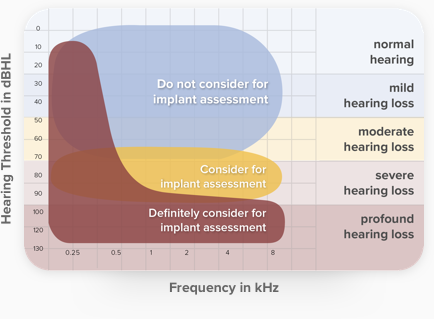
Adapted from The Ear Foundation — for reference only.
Referral guidelines.
For children
- ·Bilateral congenital or acquired severe to profound hearing loss.
- ·Failed Universal Newborn Hearing Screening (UNHS).
- ·Refer to brochure for further details.
For adults
- ·Bilateral severe to profound hearing loss.
- ·Post-lingual hearing loss with oral/aural communication skills.
- ·Limited benefit from appropriately fitted hearing aids and poor open-set speech discrimination. (Binaural amplification recommended unless total loss in one or both ears.)
Cases where urgency applies.
- i.Hearing loss post meningitis.
- ii.Hearing loss post skull fracture, particularly temporal bone.
- iii.Dual sensory disability — e.g. blindness.
How to refer.
- ·General Practitioner
- ·Local or community audiologist
- ·Consultant ENT Specialist
- ·ENT NCHDs (on behalf of supervising consultants)
Attach the supporting documentation
For children
Copy of UNHS or most recent audiological testing.
For adults
- Most recent audiological reports (no older than 6 months).
- Evidence of previous hearing aid fitting and consistent use.
- Report on the most recent hearing aid review (no older than 6 months).
Helpful — not compulsory
Copies of radiology reports, history of medical co-morbidities and current medications help us screen faster. Please advise patients to bring a CD-ROM with the latest MRI or CT scan of the inner ear on first attendance, if done at a private centre.